Enjoy a Greek wine-tasting at Oenolpi winery on Zakynthos
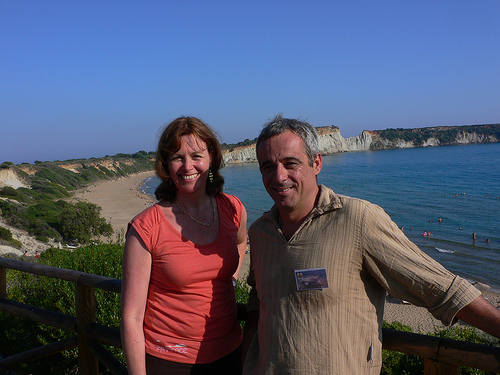
On the Greek Island of Zakynthos (Zante), I was intrigued to find that there are some serious wine makers, who are producing excellent quality wines. At the Oenolpi winery, I met Timotheos and Christina-Maria, a young couple who have started a boutique winery, mixing local grapes with mainstream varieties to produce extremely drinkable and fresh wines.
Timotheos told me how his family had bought the estate in the 1960s when the wealthy families on Zakynthos were hit by the shortage of labour after the terrible earthquake of 1953, when so many Zakynthian families migrated abroad in search of a better life.
As well as the existing local grape varieties and mainstream varieties such as Cabernet Sauvignon, the estate also includes olive trees and Korinthian grapes for raisins. In order to build up the family business, Timotheos studied winemaking in Athens where he met Christina-Maria, who was also studying Oenology. They have build a spelendid new winery at Macherado in the centre of the island, with a reception area for wine tastings and also have a shop in Zante town. Although much of their production goes to the carafes of wine that you’ll be served in the Greek restaurants, they are also focusing on making some top quality wines in the modern style, designed to be drunk young.
![]() |
![]() |
They are part of a group of wine-makers on the island who are trying to build up the reputation of the wines of Zakynthos and are holding their first wine festival in the town of Keri on 25th July 2009, which is open to the public to promote these local wines.
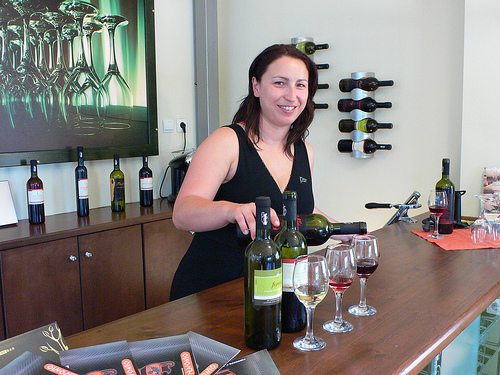
When we visited the winery, they were happy to give me a tasting of their modern style Zakynthian wines. In the beautiful countryside, surrounded by olive groves and vines, it seemed a great lifestyle, although Christina-Maria told me that she was working so hard that she never had time to go to the beach. These are the wines that we tasted;
![]() |
![]() |
Verdea white
This is a fresh white wine which is typical of Zakynthos, and the name denotes the locality in the same way that Champagne is only from a particular locality in France. It is harvested early in the season and has high acidity and citrus flavours, being designed to be drunk at a year old. We found it had very drinkable and would work well with any light, summery foods. The wine is a blend of local white grape varieties, such as Skiadopoulo, Pavlos, Goustoulidi and Robola which is also found on the neighbouring island of Kefalonia.
Pedini Christoforou Rosé
The rosé wine is named after the Christoforou family estate and like the white Verdea was fresh and fruity to be drunk young with a wide range of foods. It is made from a blend of 50% local red grape Augostoustiatis, blended with Kasta, a rosé variety and a small proportion of Alicat Bouchet. The last is a Spanish grape variety, with very dark red skins, which is added for colour and aroma.
Neotefktos Red
This red wine was named after the Greek word for Newborn, named after the newborn winery that Timotheos and Christina-Maria created. It’s a blend of local red varieties such as Augostoustiatis, Kousoubeli, Black Robola and the Cabernet Sauvignon which the couple introduced to the vineyard. Again, the local varieties give it a distinctive Greek taste, but it was very smooth and drinkable.
After we tasted the wines which are currently on sale at the Oenolpi winery, Christina-Maria told me about their other special wines that had unfortunately sold out, as they had only originally made 1000 bottles of each. If the summer continues to be good this year, they hope to bottle some more to be ready for drinking from 2010. First was a Cabernet Sauvignon blend mixed with local Black Robolo which is an expensive variety due to it’s low yield but makes excellent quality wine.
Second was a really delicious Augostoustiatis Liastos wine with 15.1% strength. The wine is made with the local Augostoustiatis grapes which are harvested and then laid outside on a cloth to be ‘burnt’ in the sun, giving it the Liastos name. The technique of ‘burning ‘ the grapes is an unusual one but was traditionally used as a natural way of concentrating the sugars and alcohol. In Greece, it is forbidden to add sugar to wines, so this is the natural alternative, making a concentrated, full-bodied wine which is great for drinking at the end of a meal with cheese or fruit. Although we were unable to taste the wine there and then, our kind friend Rob Wallace from Freddie’s Beach Bar, made us a gift of one of his remaining bottles that he had bought from Oenolpi.
We tasted it for my father’s birthday and it was delicious, tasting like liquid raisins and caramel and perfect as a desert wine. It reminded me of the taste of Christmas, to drink in front of a roaring fire, then have a pleasant doze afterwards - it certainly finished me off for the afternoon but in a good way!
If you have a hire car, it’s well worth paying the Oenolpi winery a visit at Macherado, or you can visit their wine shop in Zante town, on the main shopping street. If you visit in the mornings, you should find either Timotheos or Christina-Maria there and happy to give you a wine tasting and a tour of the winery. You can always call ahead to be on the safe side.
I also shot some video at the winery which I hope to put up in the next few weeks.
This post is part of Wanderfood Wednesday - for more delicious foodie ideas to have you salivating head over to Wanderlust and Lipstick
Timotheos G Christoforos and Christina-Maria Leftaki
Oenolpi Winery, Macherado and Zante town
Tel +30 2695094030
Mob +30 6977126414, + 30 6979728015
E-mail oenolpi@hotmail.com
Website http://www.oenolpi.gr/
You may also enjoy
How to make delicious Greek Stuffed Tomatoes
How to find a real Greek Taverna on Zakynthos
Saving the Caretta Caretta Turtles on Zakynthos
Meet the wine-makers at Chateu Musar in Lebanon
Read more travel articles at Travel Blog Home
Don’t miss out - subscribe to Heather on her travels
Business cards for bloggers from Moo
July 26, 2009 by admin
Filed under Blogging, Giveaways, Misc, Travel products
When you’re out and about in the real world spreading the word about your blog, you’ll find these cute little Mini cards from Moo are just the ticket. I find myself regularly handing them out on my travels as I talk to people about my blog. It helps to explain why I ask so many questions and take photos of everything that moves.
I wrote before about last box of Moo cards I bought for my Travels but now they’re all gone, so I’ve just received my next box and had such fun choosing new photos to put on them from my more recent travels in Greece, Lebanon, Berlin and the French Alps. I think the mini cards are more unusual myself, but if you prefer something a bit more substantial, you can choose normal sized business cards too. Having a business card adds to your credibility no end and saves you having to scribble long URLs on scraps of paper - sooo unprofessional. Even if I didn’t have a blog, I think they’d be a great thing to have if travelling for any length of time to give the many people you meet along the way, when you want to let them have your e-mail.
The Moo cards are easy to order if you have a Flickr photo-sharing account - you just drag the shots you want across to select them and can choose up to 100 different ones, or all the same as you please. The extra thing I ordered this time was this fab little Mini card Holder for £3.49 - I loved the orange but it comes in other colours and is perfect to keep on your keyring or handbag. The cards themselves cost £11.99 for the mini cards or £12.99 for the business cards.
If you’re planning to order these or any other Moo products yourself, I have a few promo codes I can give you which will give you an extra discount on any Moo products when you place your order. Just leave a comment below and I’ll send them to anyone interested - I have 3 codes for 25% off any Moo product and 2 codes for 15% off any Moo product.
P.S. I’m not earning any commission - just love my Moo mini cards and I think you will too.
You may also enjoy
Moo business cards for my travels
Pocketcomms Travel communication aid
12 Ways that Flickr can enhance your blog
Read more travel articles at Travel Blog Home
Don’t miss out - subscribe to Heather on her travels
How to make delicious Greek stuffed tomatoes
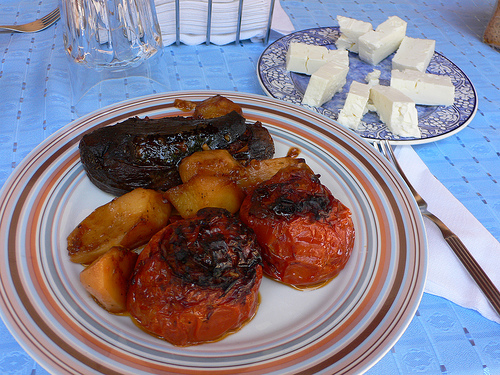
Today I ate the most delicious stuffed tomatoes, aubergine and peppers, with a filling of rice, herbs and local Greek cheese. They were cooked by Katy, my sister’s Greek mother-in-law, who we all know as Yia Yia (which means granny in Greek). I’m sure you’d like me to pass on the recipe, but it’s a bit of a long story, so here goes.
First you need to know that the Greeks are rooted to the land and every person on the island of Zakynthos where we stay has a field on the island or a vegetable patch at the back of their house, or has someone in their extended family who does. The Greeks are very particular about the provenance of what they eat. They may feed the tourists produce which is imported to the island, but for themselves, they reserve the best - and that normally means what they or their family grow, catch or raise themselves.
![]() |
![]() |
So to make your perfect stuffed tomatoes, you will first go out to the vegetable patch at the back of the house and pick your ripest red tomatoes that been baked in the sun and watered lovingly every day of the hot summer. While you’re at it, pick some of those shiny purple aubergines and the green peppers also growing out back.
![]() |
![]() |
Next go to your shed and take a few of the onions that you grew through the winter, harvested in the spring and left drying in bunches. Cut the lid off all the vegetables and scoop out the flesh of the aubergine and tomatoes and cut it into small pieces. Cook it up in your own olive oil with the chopped onions, some mint and oregano from your garden and seasoning. Add some dry rice and cook gently in the pan until the rice has swollen up, adding a bit of extra water if necessary.
Now add some pieces of local cheese, which you bought from the farmer in the spring and matured yourself covered by olive oil in a barrel lined with stones from the beach to keep the cheese from sitting in the residue. You wouldn’t trust the shop-keeper to mature the cheese, as they might not take care to use fresh oil each year, but if you’re unable to get such local cheese, you could use fetta.
Use the rice, vegetable and herb mixture to stuff your vegetables and add in some pieces of peeled potatoes, also from your vegetable patch. Pour some olive oil liberally over the vegetables from the olive trees on your land that you pressed in the autumn by shaking the trees over nets and taking the sacks of olives to the local co-operative to be pressed.
Cook the pan of stuffed vegetables in a moderate oven for 45-60 mins until they are all soft, tender and delicious.
![]() |
![]() |
Eat it all for a late lunch on the veranda in the shade. Finish your meal with some chunks of watermelon from your watermelon patch. Complete with a siesta for a couple of hours.
I think you’ll agree that eating at home in Greece gives new meaning to eating local produce.
This post is part of Photo Friday hosted at Delicious Baby. See all the other Photo Fridays here
You may also enjoy
How to find a real Greek Taverna on Zakynthos
Sunday morning Greek coffee and glika on Zakynthos
A hunter’s view in Zakynthos
Read more travel articles at Travel Blog Home
Don’t miss out - subscribe to Heather on her travels